Restore 7 min read
Lye Bath Cast Iron Restoration: The Gentlest Way to Strip a Pan
A lye bath strips decades of seasoning and crud off cast iron without touching the metal. The recipe, the safety rules, and why weeks in the tank are fine.
This guide has product links. As an Amazon Associate, Seasoned Cast earns from qualifying purchases — it never changes what we recommend.
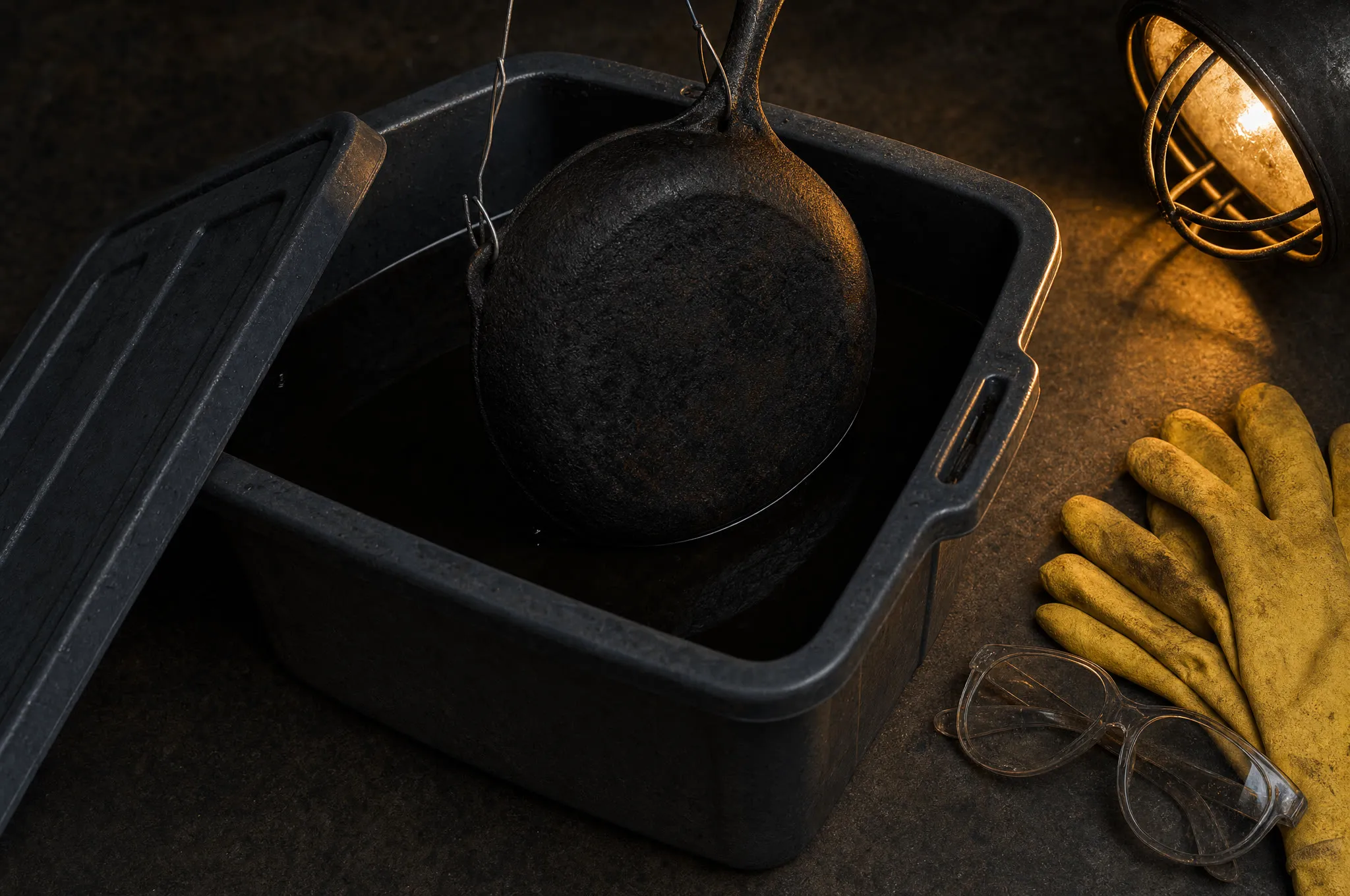
A lye bath is the gentlest way to strip cast iron to bare metal. It dissolves old seasoning, grease, and baked-on carbon completely, and it cannot harm the iron itself — a pan can sit in the tank for weeks with zero risk. The recipe: 1 pound of 100% lye dissolved into 5 gallons of cold water, in a plastic tote with a lid. Submerge the pan and let chemistry do the scrubbing.
The trade-off is upfront caution instead of ongoing effort. Mix the bath carefully once, respect what’s in the tote, and the method itself is the laziest in the whole restoration toolbox: no grinding, no sanding, no babysitting.
What lye strips — and what it can’t touch
Everything a lye bath removes is organic: seasoning is polymerized cooking oil, the black crust on a neglected pan is carbonized food and grease, and the sticky brown varnish on thrift-store finds is old oil that never hardened. Lye breaks all of it down.
Rust is different. Rust is iron oxide — a mineral — and lye has no reaction with it at all.
| On the pan | Does the lye bath remove it? |
|---|---|
| Old seasoning, even thick and flaking | Yes, completely |
| Sticky varnish and rancid grease | Yes |
| Bumpy black carbon crust | Yes, given time |
| Old paint splatter | Yes, slowly |
| Rust — orange bloom to dark brown scale | No |
This is a division of labor, not a flaw. Strip the organic crud in lye first, then deal with whatever rust is left using a vinegar soak for light rust or an electrolysis tank for heavy scale. Trying to make one method do both jobs is how pans end up half-done.
The recipe: 1 pound of lye, 5 gallons of water
You need three things: a plastic tote with a lid, cold water, and 100% lye.
The lye is sold as drain cleaner — sodium hydroxide, usually in a small tub of dry beads or flakes. Read the label before it goes anywhere near the tote: it must say 100% lye or 100% sodium hydroxide. Many drain openers are a mix, and some of them include aluminum shavings to generate heat in a clogged pipe. Aluminum and lye are a genuinely dangerous pair (more below), so a mixed product is disqualified, not just inferior.
- Set the tote where it will live — garage floor, corner of a shed, somewhere with ventilation and out of the path of kids and pets. A full tote is too heavy to move safely, so mix it in place.
- Add 5 gallons of cold water first. Cold matters: dissolving lye releases heat, and starting warm can push the mix toward spitting.
- Put on gloves and eye protection, then pour in 1 pound of lye slowly, stirring with a plastic or steel stirrer as you go. The water will get noticeably warm and may haze up. Both are normal. Stir until the beads are fully dissolved so none sit concentrated on the bottom.
- Lid on. The bath is ready as soon as it cools — no aging or curing required.
Scale the ratio to your container — half a pound in 2.5 gallons for a small tote works the same. Concentration changes speed, not outcome; the standard mix is strong enough that doubling the lye mostly buys you nothing.
Safety, stated plainly
Lye deserves respect, not fear. It’s the same chemical in every bar of soap’s ancestry, and hobbyists run lye tanks for years without incident — because they follow the same short list every time.
- Gloves and eye protection are non-negotiable. Heavy rubber gloves with long cuffs, and actual goggles rather than glasses — splashes arc in unhelpful directions. Long sleeves when mixing or pulling pans.
- Know what contact feels like. Lye on skin doesn’t burn instantly; it feels slippery first, because it’s reacting with the oils in your skin. Slippery means rinse now, with lots of plain running water. Don’t wait for a sting.
- Lid on, always. A lidded tote keeps out rain, curious dogs, and small hands. If kids or pets can reach the spot, it’s the wrong spot — or the lid gets a strap.
- Label the tote. “LYE — DO NOT OPEN” in marker costs nothing and protects whoever wanders through the garage after you.
The soak: patience is the whole method
Lower the pan in with gloved hands until it’s fully submerged — every surface under the liquid, no air pocket trapped under an upside-down pan. Lid on. Walk away.
This is the part that makes lye the gentlest strip going. Because lye can’t hurt bare iron, there is no deadline and no such thing as too long. A lightly crudded skillet might be ready in days. A century of baked-on buildup might take weeks, and that’s fine — the tank works the night shift whether you check on it or not. Warm weather speeds it up, cold weather slows it down, and neither changes the result.
Check once a week. When the seasoning has gone soft and sludgy — it often hangs off the pan in dark sheets — it’s ready for a scrub.
Scrub, rinse, repeat
- Pull the pan with gloves on and let it drip back into the tote for a moment.
- Rinse under running water — a hose over grass is fine, so is a utility sink.
- Scrub with a stiff brush or scouring pad. Softened seasoning wipes and peels off in satisfying sheets. Bare gray iron appears wherever the crud is done.
- Stubborn patches go back in the tank. No extra effort, no stronger mix — just more time. Repeat the cycle until the whole pan is clean gray metal.
Thick carbon on the outside walls and around the pour spouts usually takes the most rounds. That’s normal; it’s the thickest deposit on the pan.
The neutralizing myth
Old forum threads insist a stripped pan must be “neutralized” in vinegar before it’s safe. It’s a myth with good intentions. Lye is completely water-soluble — a thorough rinse and scrub under plain running water removes all of it. Rinse until the surface no longer feels slippery, give it one wash with dish soap if it makes you feel better, and the pan is clean. A vinegar dip doesn’t hurt anything, but it’s solving a problem the hose already solved.
Dry and season the same day
Bare stripped iron has no protection at all, and flash rust can show up before the pan even finishes air-drying. Don’t give it the chance:
- Dry the pan on a burner over medium heat until every trace of water is gone and the pan is too hot to touch.
- Get the first thin coat of oil on while it’s warm and head straight into a full oven seasoning session — two or three thin coats at 450–500°F.
If the strip revealed orange underneath the old seasoning, detour first: take the rust off with vinegar or scrubbing — or the electrolysis tank for heavy pitting and scale — then dry and season immediately. Stripped, de-rusted, seasoned: that’s the full restoration sequence, and lye is step one, not the whole story.
A lye bath asks for ten careful minutes at mixing time and pays you back with the easiest strip in cast iron: no sanding scars, no grinder marks, no weekend lost to elbow grease. Mix it once, respect the tote, and let time do the ugly part.
FAQ
How long can cast iron stay in a lye bath?
Indefinitely. Lye dissolves organic material — old seasoning, grease, carbon — and has no reaction with iron. Once the crud is gone, nothing further happens to the pan. A week is typical, a month is common for heavy buildup, and forgetting a pan in the tank costs you nothing but time.
Will a lye bath remove rust?
No. Rust is iron oxide — a mineral, not an organic residue — and lye has nothing to react with. A lye bath often reveals rust that was hiding under old seasoning. Strip in lye first, then take the rust off with a vinegar soak or an electrolysis tank, then dry and season immediately.
Do I need to neutralize the pan with vinegar after a lye bath?
No. Lye is completely water-soluble, so a thorough rinse and scrub under running water removes it. The vinegar-neutralizing step you'll see in old forum posts doesn't hurt anything, but it solves a problem that plain water already solved. If the pan is rinsed until it no longer feels slippery, it's clean.
Can a pan with wooden or aluminum parts go in the bath?
No aluminum, ever — lye dissolves it and releases hydrogen gas in the process. Wood handles and finishes get destroyed too, so unscrew and remove them first. The tank is for bare cast iron and plain steel only. If a part can't come off and isn't iron or steel, strip that piece another way.