Care 7 min read
Why Is My Cast Iron Smoking? (When It's Normal and When to Stop)
A smoking cast iron pan is usually leftover oil burning off or an oil past its smoke point. Here's the quick diagnosis for all five causes — and when to stop.
This guide has product links. As an Amazon Associate, Seasoned Cast earns from qualifying purchases — it never changes what we recommend.
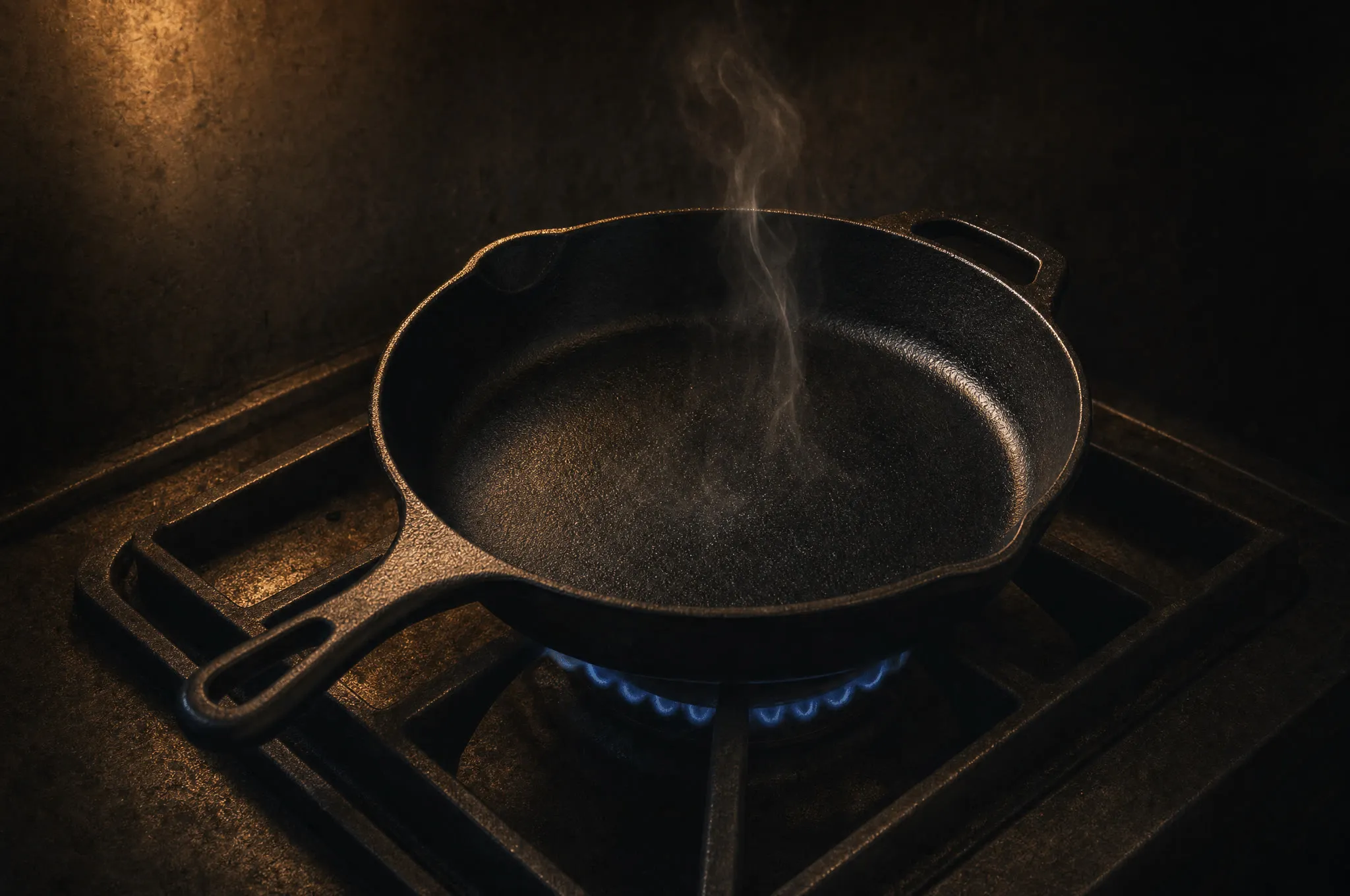
A smoking cast iron pan usually means oil is burning — and most of the time that’s harmless. A thin haze while the pan preheats is last night’s wipe-down oil burning off. Steady smoke the moment your cooking fat hits the pan means that oil is past its smoke point: too much heat for that fat. Neither one is an emergency.
Here’s how to read the smoke, work out which of the five causes you’ve got, and spot the one version that actually means stop.
Read the smoke: the 30-second diagnosis
When the smoke starts and what it smells like tells you nearly everything.
| When it smokes | What it is | What to do |
|---|---|---|
| Thin haze early in the preheat, gone in a minute or two | Storage oil from the last wipe-down burning off | Nothing — normal |
| Steady smoke as soon as cooking oil hits the pan | Oil pushed past its smoke point | Off the heat, wipe out, restart cooler or switch fats |
| Light smoke during the first few cooks after seasoning | New seasoning finishing its cure | Normal — keep cooking |
| Smoke with a crayon or old-paint smell | Rancid surface oil | Scrub back, re-oil thin |
| Sharp, acrid smoke from black specks or patches | Food residue or sugar burning | Cool it, clean it properly |
The causes below are ranked — the top of the list covers most smoking pans.
1. Leftover surface oil burning off
If you finish each wash by wiping in a few drops of oil — good habit, keep it — the next preheat burns that film off. You get a minute or two of light haze, then it stops. That’s not a problem; it’s a bonus. The burn-off polymerizes the film into a whisper-thin layer of new seasoning. The pan is maintaining itself.
If the haze is more of a plume, you left too much oil on at storage time. Let it burn off with the fan running, and next time buff the pan with a dry towel until it looks unoiled. The film you can’t see is the right amount.
2. Your cooking oil can’t take the heat
The most common cause of smoke while food is cooking is simple: the fat in the pan is past its smoke point — the temperature where it stops being oil and starts breaking down. Past that line it smokes, tastes scorched, and turns bitter fast.
Cast iron makes this easy to do. The pan is a heat battery — leave it on a high burner while you trim the steak and the cooking surface can sail past 500°F, hotter than any common kitchen oil can stand.
Rough numbers for the usual suspects:
| Fat | Approximate smoke point | Verdict for cast iron |
|---|---|---|
| Butter | ~300–350°F | Medium heat only — the milk solids burn first. Add it at the end of a sear, not the start |
| Extra-virgin olive oil | ~350–410°F | Fine for everyday medium-heat cooking; wrong tool for a hard sear |
| Grapeseed | ~390–420°F | Solid all-rounder, and a favorite for seasoning coats |
| Canola | ~400–450°F | Cheap, neutral, handles most stovetop work |
| Ghee (clarified butter) | ~450–485°F | Butter flavor with the burnable milk solids removed |
| Refined avocado | ~480–520°F | The high-heat pick. If your pan smokes a lot, start here |
These are ballparks, not lab data — smoke point shifts with brand, refinement, and age. An old, often-opened bottle smokes earlier than a fresh one.
Two fixes; either works. Match the fat to the heat — searing gets avocado or canola, butter gets eggs and finishing duty — or match the heat to the fat: cooking in butter means the pan stays at medium.
3. New seasoning is still curing
A pan fresh off an oven seasoning often smokes lightly through its first few cooks. The outermost layer of oil isn’t fully polymerized yet, and stovetop heat finishes the job. Expect a little haze on cooks one through three, fading each time. Normal — keep cooking; cooking is what completes the cure.
If it’s still smoking heavily after that, or the surface feels tacky, the coats went on too thick. That’s the same failure that causes a sticky pan, and the same fix applies: wipe hard and give it a hot, dry bake.
4. Rancid oil — the crayon smell
Oil left sitting on a stored pan slowly oxidizes. Heat it weeks later and you get smoke with an unmistakable smell: crayons, old paint, stale nuts. It isn’t dangerous, but it gets into food, and it means the surface film has gone off.
Don’t cook through it. Scrub the cooking surface back with hot water, a brush or chainmail scrubber, and yes, soap is fine — you’re removing the rancid film, not the hard seasoning under it. Dry the pan on a burner until every trace of water is gone, wipe in a drop of fresh oil, buff it out. Done.
Prevention is storage discipline: buff the pan to dry-looking before it goes in the cupboard, and cook with it more often. Pans that work every week don’t go rancid.
5. Food residue and sugar burning
Black specks that smoke and smell acrid are the last meal carbonizing — stray fond, a film of sugary marinade, the ghost of barbecue sauce. Sugar is the repeat offender: it chars well below searing temperatures and will smoke every time the pan gets hot until it’s gone.
The fix is just cleaning. Cool the pan, scrub with coarse salt or chainmail, wash, dry hot, thin wipe of oil. If one spot keeps smoking after cleaning, it’s usually burnt-on residue pretending to be seasoning — scrub it back until the surface feels smooth.
When smoke is fine — and when it means stop
Some smoke is part of the job:
- The seasoning bake. An hour at 450–500°F is supposed to haze up the kitchen — that’s the polymer forming. Ventilate and let it work.
- A hard sear. A short plume when the steak hits a properly hot pan is the sound of a crust forming. It should peak and settle, not build.
- The preheat haze. Cause 1 above. A minute or two, then gone.
Smoke means stop when it’s building instead of passing: a pool of oil billowing before the food is even in, anything acrid, smoke turning thick and dark. Take the pan off the heat, let it settle, wipe it out, and restart lower.
Ventilation: cast iron cooking is honest about smoke
Run the hood fan before the pan gets hot, not after the room is hazy — a hood clears a trickle far better than a cloud. Crack a window for cross-draft. And treat the oven seasoning bake as the smokiest event in the rotation: hood on and window open, or run it in a covered grill outside and keep the kitchen out of it entirely.
The “my smoke detector goes off every time” fix
If every steak night ends with a broom handle waving at the ceiling, change how the pan gets hot instead of relocating the detector:
- Preheat gentler. Medium heat for four or five minutes beats two minutes on max. You arrive at the same searing temperature without overshooting into every oil’s smoke zone.
- Oil later. Don’t let oil ride through the whole preheat — it just sits there breaking down. Bring the pan to temperature dry, add the oil, and have the food in within seconds.
- Thinner everything. Less oil in the pan while cooking, and post-cook wipe-downs buffed until the pan looks dry. Excess oil today is smoke tomorrow.
A smoking pan is the most talkative pan in the kitchen — it tells you when it’s maintaining itself, when the wrong oil got the job, and when something needs a scrub. Read the smoke, adjust one variable, and it goes back to quietly doing its work. The rest of the routine lives in the care basics.
FAQ
Is it safe to cook food in a smoking cast iron pan?
Mostly, but it's not ideal. A little haze during the preheat is harmless. If the cooking oil itself is smoking hard before the food goes in, it's breaking down and will hand the food a bitter, scorched taste. Pull the pan off the heat, wipe out the oil, and restart slightly cooler with fresh oil.
Why does my cast iron smoke with nothing in it?
Almost always the thin film of oil from its last wipe-down burning off, or fresh seasoning still finishing its cure. Both make a brief haze that fades within a couple of minutes. If an empty pan pours smoke, the last coat went on too thick — let it burn off with the fan running, then buff future coats down to almost nothing.
What's the best oil for high-heat searing in cast iron?
Refined avocado oil is the comfortable pick, with canola and grapeseed close behind. Save butter and extra-virgin olive oil for medium heat, or add butter at the end of a sear for flavor — its milk solids burn long before searing temperatures.
Can smoking damage the pan or its seasoning?
The pan itself, no — cast iron shrugs off anything a home stove can produce. The seasoning, eventually: repeated empty preheats on max heat can burn seasoning into gray, ashy patches. If that happens, the fix is a scrub and a few thin oven coats, not a new pan.